

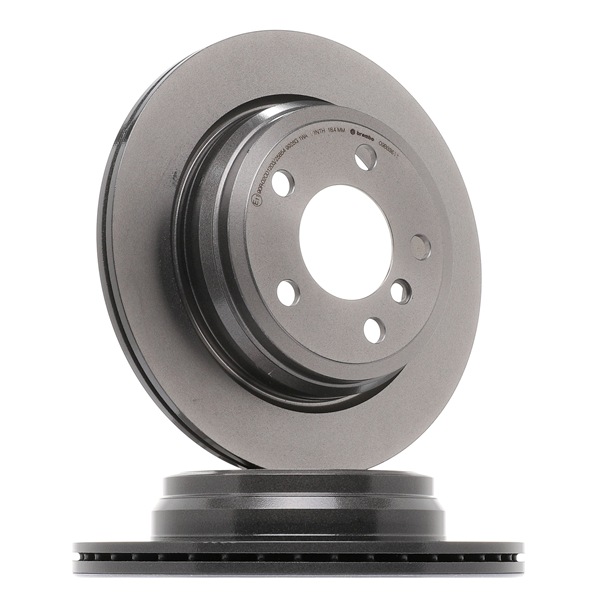
Brake disc ATE 24.0120-0240.1 300,0x20,0mm, 5x120,0, Vented


Brake disc ATE 420240
- Diameter: 300,0
- Brake Disc Type: Vented
- Number of Holes: 5
- Bolt Hole Circle Ø [mm]: 120,0
- Brake Disc Thickness: 20,0
- Minimum thickness [mm]: 18,4
- Centering Diameter [mm]: 75,0
- Inner Diameter [mm]: 185,0
- Height: 66
- Surface: Coated
- Machining: High-carbon
- MAPP code available
- Test Mark: E1 90R-02C0115/0302
- Bore Diameter [mm]: 16,5
- Supplementary Article / Supplementary Info Info 2: with bolts/screws
- Drilled: no
- Condition: New
Check the OE number
ATE 24.0120-0240.1 Brake disc – Key Features & Performance
The ATE 24.0120-0240.1 Brake disc ensures consistent stopping capability through precise thermal management and structural casting integrity. By maintaining low lateral run-out during engagement, this component provides reliable contact area for pad friction materials. Engineers specify this unit for its ability to minimise thickness variation, which supports predictable pedal modulation under varied load conditions.
Establishing high braking performance for vehicle safety
Achieving high braking performance relies upon the metallurgical composition of the casting. These 24.0120-0240.1 ATE Brake discs provide maximum stopping power during repeated deceleration cycles. Integration of improved braking efficiency ensures that system response remains linear. Drivers notice high friction performance when navigating demanding gradients. Maintaining strong braking force remains essential for daily operational safety.
Positioning among top brands in braking components
Modern workshops prioritise quality brands that guarantee dimensional consistency across large production batches. Selecting the best brake disc brands mitigates the risk of early replacement due to material fatigue. Utilising reputable manufacturers simplifies the installation process for the professional technician. Well-known brands undergo rigorous bench testing to confirm load-bearing limits. ATE 24.0120-0240.1 serves as an example of trusted brands meeting modern vehicle standards.
Maintaining the premium class of automotive components
Engineers classify the ATE 24.0120-0240.1 Brake disc set as an example of premium quality engineering. By selecting top-tier brands, vehicle owners ensure hardware compatibility with electronic safety systems. These units adhere to OE quality standards to ensure flawless integration. High-end metallurgy supports consistent hardware geometry under intense pressure. Choosing a premium solution guards against premature component failure during the service interval. Professional grade hardware remains the standard for fleet maintenance. Selecting top quality components reduces long-term vehicle ownership costs.
Managing heat resistance during intensive use
Effective heat resistance prevents the premature crystallization of friction pads during sustained mountain descent. Keeping a component heat resistant allows for rapid recovery after repeated stops. High temperature resistance is achieved through specific carbon-to-iron ratios in the foundry process. Using fade-resistant materials ensures the system maintains its engagement pressure. The ATE 24.0120-0240.1 Brake discs exhibit thermal stability even when pushed to maximum operating limits. This design handles high heat without losing structural rigidity.
Minimising low vibration during rotational movement
Smooth rotation of the hub assembly depends on the inherent balance of the rotating mass. Proper anti-judder characteristics prevent the transmission of uneven forces to the chassis. Experienced mechanics report no steering wheel wobble when using these precision-balanced units. Preventing no vibration requires strict adherence to centrifugal balancing protocols. Integrating these ATE 24.0120-0240.1 Rotors reduces harmonic disturbance across the suspension geometry.
Optimising cooling efficiency for thermal management
Fast heat dissipation is critical for preventing thermal shock in high-performance braking systems. The casting incorporates optimised airflow paths to draw ambient air into the centre of the unit. Integral cooling channels facilitate the rapid exchange of energy during heavy duty application. Being ventilated ensures that the friction surface temperatures remain within acceptable limits. Improved cooling prevents the softening of iron structures during extreme service cycles.
Applying protective measures for coated discs
The application of an anti-rust coating ensures the non-contact areas remain free from oxidative scaling during storage. This protective layer maintains aesthetic standards whilst preventing the buildup of debris around the hub mounting. These coated discs arrive ready for immediate installation without degreasing. Every 24.0120-0240.1 ATE component features a precision painted finish for enhanced durability.
Improving warp resistance in thermal cycles
Achieving a warp-resistant structure requires slow, controlled cooling after the casting process to relieve residual internal stresses. Each unit maintains shape under heat to ensure the pedal feel remains consistent. The geometry stays stable under stress regardless of the number of thermal cycles experienced. Being deformation-resistant ensures the disc surface remains parallel to the caliper piston throughout its lifecycle.
Utilising ventilated discs for rotor life
Internal cooling vanes allow for the rapid evacuation of gaseous boundary layers. This internally ventilated architecture provides a larger surface area for heat exchange. These ventilated discs remain structurally sound even when the mass is reduced for weight efficiency. The optimised airflow design promotes long-term reliability in adverse climate conditions.
ATE 24.0120-0240.1 Brake discs: Key Performance and Safety Highlights
The 24.0120-0240.1 ATE Rotors offer significant advantages for modern vehicle maintenance and road safety. By focusing on thermal management and geometric accuracy, these components ensure a stable transition between speed and rest. The following table details the functional attributes of this hardware.
| Braking Attribute | Performance Benefit |
|---|---|
| Stopping power | improved braking efficiency |
| Brand positioning | reputable manufacturers |
| High-end quality segment | OE quality |
| Thermal stability | fade-resistant materials |
| Judder-free operation | no steering wheel wobble |
| Heat dissipation efficiency | cooling channels |
| Protective anti-corrosive coating | protective layer |
| Geometric stability | stable under stress |
| Internally vented design | internally ventilated |
Selecting the correct hardware is essential for maintaining the intended safety parameters of the chassis. ATE 24.0120-0240.1 provides high friction performance through meticulous engineering. It is recommended that technicians follow torque specifications strictly during the installation of this high-friction component.
Why the ATE 24.0120-0240.1 Brake disc is an Excellent Choice
Investing in OE quality parts ensures that the metallurgical properties match the original design intent of the vehicle manufacturer. These components offer superior cost-per-mile efficiency by resisting uneven wear patterns over extended periods. Precision casting reduces the likelihood of thickness variation, which directly extends the operational life of the pads. Choosing this hardware ensures that the system maintains equilibrium between structural longevity and braking efficacy.
The ATE 24.0120-0240.1 stands out due to its rigid manufacturing tolerances and consistent thermal performance. This ATE 24.0120-0240.1 represents a reliable choice for any professional service facility. Every ATE 24.0120-0240.1 Brake disc set undergoes testing to verify mechanical safety limits. Please consult the vehicle manufacturer's technical guide for correct fitment compatibility with your specific hub assembly.

24.0120-0240.1 ATE brake discs are a hallmark of reliability and efficiency in any conditions.
As innovations are widely used during the production process, a rapid stop of the vehicle is ensured at emergency braking.
The discs are lightweight which means the car has to carry less unsprung mass, improving its dynamic performance.
They are resistant to overheating and cool rapidly.
An optimal friction coefficient prevent 24.0120-0240.1 ATE brake discs from grooves formation and do not result in brake pads premature wear-out.



![ATE Brake discs Minimum thickness [mm]: 18,4 420240 with American Express pay](/assets/common/images/svg/payments/american_express.svg?v=1778235218)
![Brake rotors Centering Diameter [mm]: 75,0 (ATE, 24.0120-0240.1) with Bank Transfer pay](/assets/833652/images/svg/payments/en/unicredit_bank.svg?v=1778361463)